The Numbers and Who Counts Them
A Pint Sold Across Your Own Bar Is Worth Several Sold Through a Distributor
Photo: ELEVATE / Pexels
The three-tier system carves up every distributed dollar before the brewery sees it. A taproom pint skips two of those cuts entirely — and that arithmetic remade craft brewery economics.
The Math of the Middle
The three-tier system — the US legal structure separating producers, distributors and retailers into three distinct commercial tiers — was designed for regulatory control, not brewery profitability. Its side effect is that every barrel shipped through distribution passes through at least two margin-taking hands before the money comes back to the brewer.
The Brewers Association has published benchmark data showing that a small independent craft brewery selling through distribution typically nets somewhere between $100 and $200 per barrel after distributor margin (usually 25–30 percent of wholesale) and retailer markup (another 25–40 percent on top of that) are both removed. The exact figure varies by state, contract and package type, but the structural compression is consistent: the brewer who prices a keg to a distributor is already starting from a position where two downstream parties must each cover their own operating costs before the consumer pays.

The board is the clearest read on style rotation there is — it changes months before the annual figures do.
Photo: Viktorya Sergeeva 🫂 / PexelsA taproom transaction eliminates both. When a brewery sells a pint across its own bar, it collects the retail price directly. The Brewers Association's annual craft brewery financial benchmarking, reported across multiple survey years, has consistently found taproom revenue per barrel running between $700 and $1,100 — against distributed revenue that can run below $200 per barrel for smaller producers. That is not a rounding difference. It is the difference between a viable business model and a marginal one.
Why the 2010s Were the Taproom Decade
Brewery counts in the United States roughly quintupled between 2010 and 2019, according to Brewers Association data, going from around 1,700 to more than 8,000. A substantial portion of that growth was not regional distribution plays — it was small-format taproom operations explicitly built around the direct-sale margin. The math made the model: a brewery moving 500 barrels a year through a taproom can generate more gross revenue than one moving 2,000 barrels through a distributor network, with none of the logistics, compliance overhead or slotting pressure that distribution entails.
Key ratios
State-level franchise laws had long protected distributors from being dropped by suppliers, which meant that once a brewery signed a distribution agreement, renegotiating margin or switching partners was legally difficult and often expensive. The taproom model was partly a rational response to that locked structure. Breweries that kept volume small and sold direct were not choosing romanticism over scale — they were choosing a margin profile that the three-tier system made unavailable any other way.
The price-per-barrel metric clarifies something the volume figures obscure. Craft beer's dollar share of the US market has consistently run well above its volume share — craft represented around 13 percent of volume but roughly 24 to 26 percent of retail dollar sales by the early 2020s, per Brewers Association estimates. Taproom pricing is part of what pulls that ratio apart: a $9 pint of IPA sold over a brewery bar contributes to retail dollar calculations at a rate no $12 four-pack sold through a grocery chain can match per-unit.
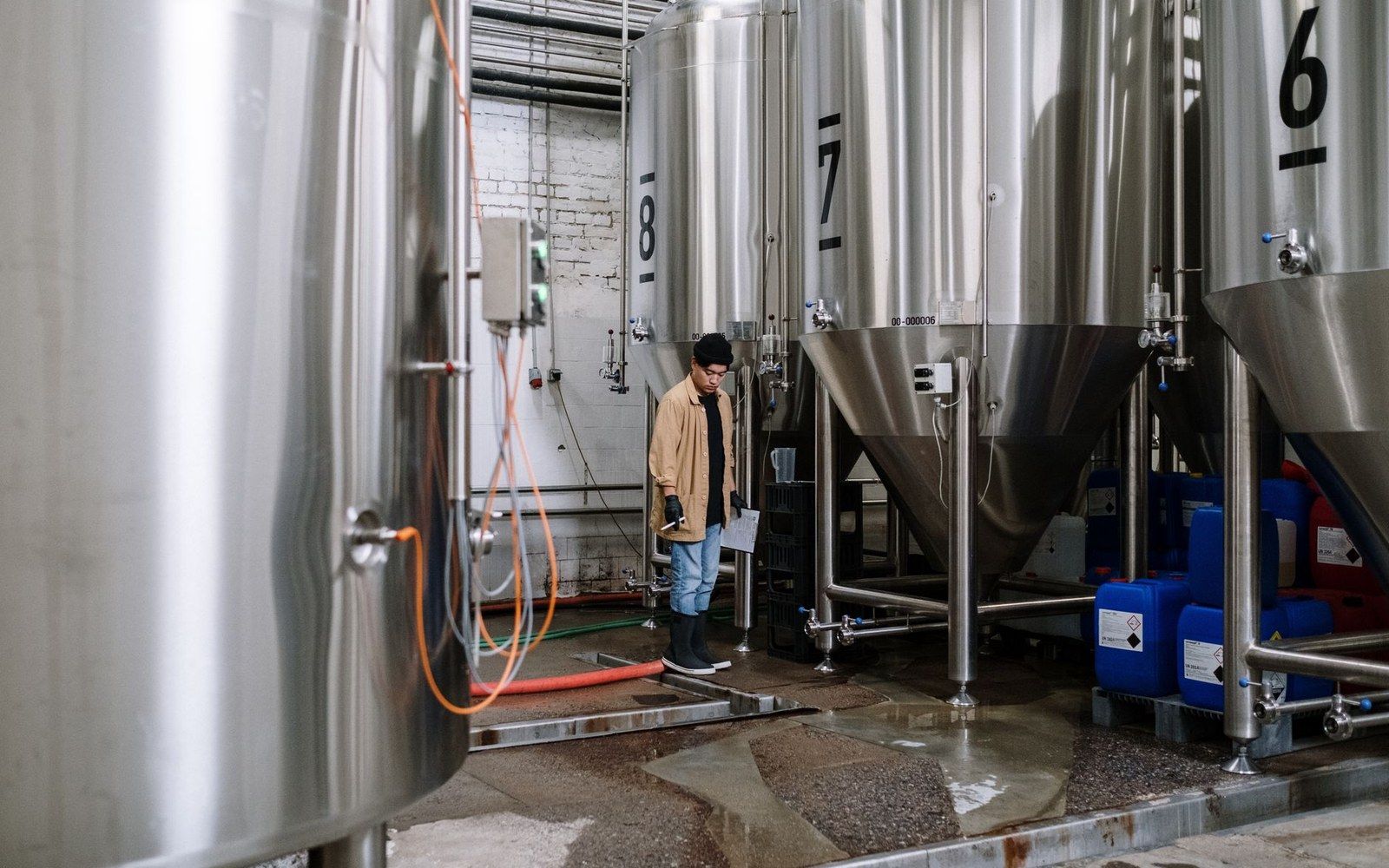
Fermenter capacity bought during the boom is the asset most closures leave behind.
Photo: cottonbro studio / PexelsWhat the Numbers Actually Mean
None of this means distribution is irrational. Volume growth beyond a few thousand barrels, regional brand recognition and retail presence are not achievable from a taproom alone. Boston Beer Company, Sierra Nevada and other scaled regional and national producers built durable businesses on distributed volume, accepting the margin compression in exchange for reach. But the microbrewery and taproom boom of the 2010s demonstrated that at small scale, the arithmetic of direct sales is categorically better — not marginally, but by a factor of three to five depending on the state and the operation.
The three-tier system was not going anywhere. The taproom model was simply the discovery that, within its constraints, one business structure was far more efficient than another — and that you had to measure it in dollars per barrel, not barrels alone, to see it clearly.