What Is Actually Being Brewed
Athletic Brewing Is Now a Top-Twenty US Brewer by Volume
Photo: Vinícius Caricatte / Pexels
A brewery founded in 2017 that makes exclusively non-alcoholic beer has climbed into the Brewers Association's list of the twenty largest US breweries by volume — a fact that would have been structurally impossible a decade ago.
From Stratford to Scale
Bill Shufelt and John Walker founded Athletic Brewing Company in Stratford, Connecticut in 2017 with a proposition the American market had not tested at scale: a craft brewery built entirely around non-alcoholic beer. No alcoholic flagships to cross-subsidise the portfolio, no legacy brand to protect — just NA product from day one. By the early 2020s the company had added a second production facility in San Diego, California to meet demand that its original Connecticut plant could not absorb alone.
The Brewers Association, which publishes annual rankings of US craft breweries by volume, tracks Athletic's output through the same excise-tax return pipeline that governs every licensed brewer's federal reporting. By the mid-2020s, Athletic's barrel count had placed it inside the organisation's top-twenty list — a cohort otherwise populated by regional institutions with decades of distribution history behind them. The ranking reflects barrels shipped, not dollar revenue, which makes Athletic's position more remarkable: NA beer commands a price-per-barrel premium over standard lager but generates no additional volume credit for it.
Chronology
- 2017Athletic Brewing Company founded by Bill Shufelt and John Walker in Stratford, Connecticut
- Early 2020ssecond production facility opened in San Diego, California
- Mid-2020sBrewers Association rankings place Athletic inside the top twenty US breweries by volume
- 2023Circana off-premise data records double-digit percentage growth in NA beer dollar sales
The broader context matters. No- and low-alcohol beer was the one volume segment growing consistently across both craft and macro channels while the wider US beer market contracted. Circana retail data for 2023 showed NA beer growing at a double-digit percentage rate in off-premise dollar sales even as total beer category dollars were essentially flat. Athletic was not simply riding a category tailwind — it was the category's largest craft-tier participant, making its own volume trajectory and the segment's expansion nearly synonymous in trade conversation.
The brewery operates under the same three-tier system as every other US producer, moving product through distributors to retail and on-premise accounts. What differs is the retail footprint: Athletic's cans appear in grocery chains, natural-food retailers and convenience formats that conventional craft breweries rarely penetrate at comparable volume, giving it a distribution profile closer to a mid-size regional lager brand than a typical independent craft operation.
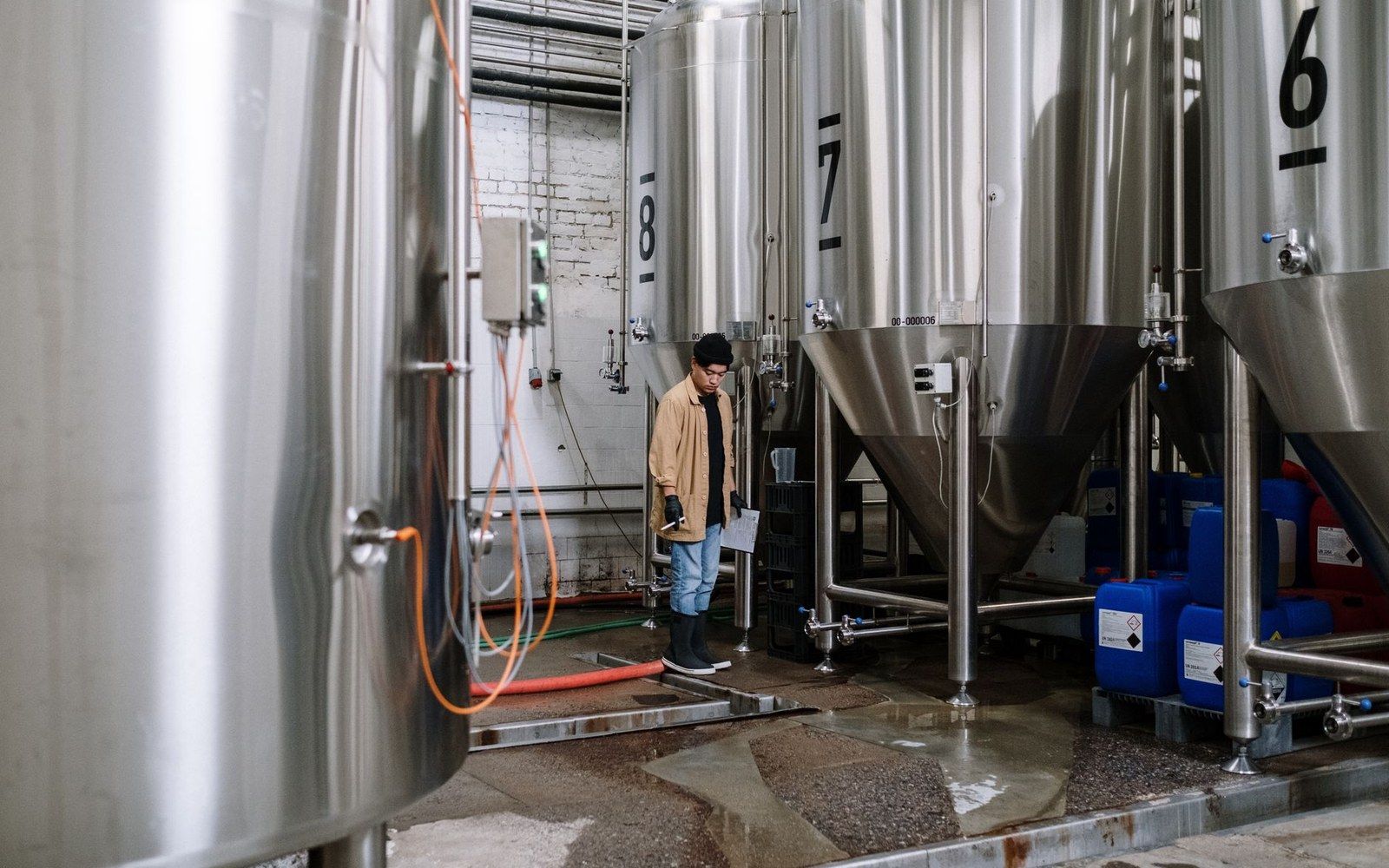
Tank capacity is the constraint behind the lager swing: cold conditioning holds a vessel for weeks rather than days.
Photo: cottonbro studio / PexelsAchieving top-twenty status without a single alcoholic SKU is a structural fact the Brewers Association's own historical data cannot easily accommodate — the trade definition of "craft" has always been primarily volume-and-independence based, not style-based, which is precisely why Athletic qualifies. What the ranking does not capture is how thoroughly one Stratford startup reshaped what the non-alcoholic shelf is expected to deliver.